
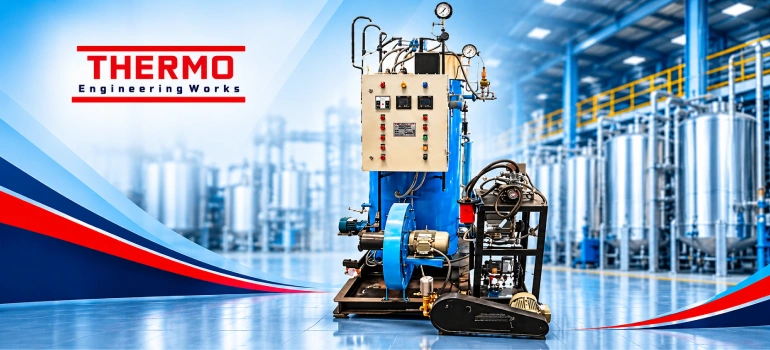
When Should Industries Choose Non IBR Steam Boilers Instead of IBR Boilers?
Steam plays an important role in industrial operations, supporting processes such as heating, drying, sterilisation, cooking, cleaning, and manufacturing. Industries that depend on continuous steam generation need to select the right boiler system based on their operational requirements, steam pressure, capacity, safety standards, and installation conditions. One of the most common decisions businesses face is whether to invest in an IBR (Indian Boiler Regulations) boiler or a Non-IBR steam boiler.
Both boiler categories serve industrial heating requirements, but they differ in regulatory applicability, design considerations, operating conditions, and documentation requirements. For industries that require steam at relatively lower pressures and within the applicable regulatory limits, Non-IBR steam boilers can offer a practical solution.
But when should an industry choose a Non-IBR steam boiler instead of an IBR boiler? The answer depends on the nature of the industrial process, applicable Indian regulations, steam requirements, operating costs, and future production plans.
Thermo Engineering Works helps industries understand their steam generation requirements and identify suitable boiler solutions for their applications. This guide explains the differences between IBR and Non-IBR boilers, their advantages, industrial applications, selection criteria, and important considerations for businesses.
What Is a Non-IBR Steam Boiler?
A Non-IBR steam boiler is a steam-generating system that falls outside the applicability of the Indian Boiler Regulations (IBR), based on the relevant technical definitions, pressure, volume, and other prescribed conditions.
IBR is an Indian regulatory framework governing the design, construction, inspection, testing, registration, and operation of boilers and associated components within its scope.
Non-IBR boilers are generally considered for applications that meet the applicable statutory exemptions. They are commonly used in smaller industrial operations and processes where steam demand, pressure, and capacity requirements are comparatively limited.
However, Non-IBR does not mean that a boiler is free from safety requirements. Industries must still comply with applicable factory safety provisions, electrical requirements, environmental regulations, pressure-system requirements, and other relevant statutory obligations.
Key Characteristics of Non-IBR Steam Boilers
- Regulatory applicability: Designed for applications that fall outside the applicable IBR requirements.
- Lower-capacity applications: Often suitable for small and medium-scale steam requirements.
- Compact installation: Certain models are designed to occupy less floor space.
- Operational flexibility: Can be suitable for businesses with moderate or intermittent steam consumption.
- Application-specific selection: Available configurations depend on the required steam pressure, temperature, fuel, and output.
- Industrial usability: Used in different sectors for heating, processing, cleaning, and other steam-related activities.
What Is an IBR Steam Boiler?
An IBR steam boiler is a boiler that comes under the Indian Boiler Regulations and must comply with the relevant statutory requirements.
These regulations establish standards for boiler design, manufacturing, material selection, fabrication, inspection, testing, certification, registration, and operation. They are intended to maintain safety and reliability in industrial steam generation.
IBR boilers are commonly selected for industrial operations that require higher steam capacities, pressures, or applications falling within the regulatory definition of a boiler.
Important Features of IBR Steam Boilers
- Regulatory compliance: Must meet applicable Indian Boiler Regulations.
- Inspection requirements: Subject to prescribed inspections and testing.
- Registration: Requires registration and associated statutory documentation where applicable.
- Industrial applications: Commonly used in large-scale manufacturing and process industries.
- Pressure handling: Designed and manufactured according to the applicable pressure and technical requirements.
- Operational documentation: Requires appropriate records, certificates, and statutory approvals.
When Should Industries Choose Non-IBR Steam Boilers Instead of IBR Boilers?
Industries should consider Non-IBR steam boilers when their process requirements fall within the applicable Non-IBR exemption limits and they need a steam-generation system suited to relatively smaller or moderate operations.
The following situations can help businesses identify when a Non-IBR boiler may be appropriate.
1. When Steam Pressure Requirements Are Low
Steam pressure is one of the important factors in selecting an industrial boiler.
Industries that require steam at relatively low pressures for heating, cleaning, drying, or basic processing may find a suitable Non-IBR boiler configuration.
For example:
- Small food processing facilities requiring steam for heating.
- Commercial laundry units using steam for cleaning.
- Small manufacturing units requiring process heating.
- Facilities using steam for washing and sanitisation.
The boiler must be selected according to the required working pressure, steam output, and applicable regulatory classification.
2. When the Industry Has Limited Steam Consumption
Not every industrial operation requires a high-capacity boiler. Small and medium-sized businesses may need steam only for specific production activities.
In these situations, a suitably sized Non-IBR boiler may help avoid investing in an unnecessarily large steam-generation system.
Potential applications include:
- Small-scale food production.
- Packaging and processing units.
- Textile washing facilities.
- Commercial garment manufacturing.
- Small industrial cleaning operations.
Selecting the correct boiler capacity helps maintain efficient operation without excessive steam generation.
3. When the Boiler Falls Within Applicable IBR Exemptions
Regulatory applicability should be one of the first considerations when selecting a boiler.
Under the Indian Boiler Regulations framework, certain steam-generating equipment may qualify for exemption depending on the prescribed technical conditions.
For example, the commonly referenced statutory definition includes an exemption for steam-generating vessels with a capacity below 25 litres and certain pressure-related conditions. However, the complete statutory definition and applicable amendments must be checked before classifying equipment.
Industries should not assume that a boiler is Non-IBR simply because it operates at a low pressure or has a small capacity.
Consulting a qualified boiler manufacturer and the relevant boiler authority can help establish the correct regulatory classification.
4. When Installation Space Is Limited
Industrial facilities sometimes operate within buildings where available floor space is restricted.
Certain Non-IBR boiler models offer compact configurations that can be considered for facilities with limited installation areas.
They may be useful for:
- Small manufacturing plants.
- Commercial kitchens.
- Food processing facilities.
- Laundry establishments.
- Workshops and production units.
However, installation space should not be the only selection factor. Adequate access for maintenance, ventilation, fuel storage, safety clearances, and operation must also be considered.
5. When the Business Needs a Smaller Initial Investment
Budget planning is an important part of industrial equipment selection.
Depending on the boiler design, capacity, fuel type, and installation requirements, a Non-IBR boiler may involve a lower initial investment than a comparable IBR installation.
Potential cost advantages may include:
- A suitable system for smaller steam requirements.
- Reduced installation complexity in certain configurations.
- Lower equipment requirements for appropriately sized applications.
- Simplified statutory procedures where the equipment genuinely qualifies for exemption.
However, industries should compare the complete lifecycle cost rather than focusing only on the purchase price.
Fuel consumption, water treatment, maintenance, spare parts, energy efficiency, and operating labour all contribute to the total cost of ownership.
6. When Steam Demand Is Intermittent
Some industrial operations do not require steam throughout the working day.
For businesses with occasional or batch-based steam requirements, a suitably selected Non-IBR boiler may be a practical option.
Examples include:
- Batch-based food processing.
- Small-scale chemical processing.
- Laundry operations with variable workloads.
- Periodic cleaning and heating activities.
- Small manufacturing facilities with limited production schedules.
The boiler capacity should match the maximum expected steam demand and the required recovery time.
7. When the Application Does Not Require a Large Industrial Boiler
Industries should avoid choosing a large boiler when their production process does not require that level of steam generation.
A properly sized Non-IBR boiler can be considered for applications where the required steam output and regulatory classification support its use.
This approach can help businesses maintain appropriate equipment utilisation and avoid unnecessary investment.
Can Industries Upgrade from Non-IBR to IBR Steam Boilers?
Yes. Industries may upgrade from a Non-IBR boiler to an IBR boiler when production requirements increase or the existing steam-generation arrangement no longer meets their needs.
Common reasons for upgrading include:
- Increased manufacturing capacity.
- Higher steam consumption.
- Increased operating pressure requirements.
- Expansion into new production processes.
- Additional machinery requiring steam.
- Changes in applicable regulatory requirements.
Before upgrading, businesses should conduct a steam-demand assessment, evaluate the existing boiler room, review fuel infrastructure, and determine the statutory requirements for the proposed installation.
An appropriately planned upgrade can help support future industrial growth.
Why Choose Thermo Engineering Works for Industrial Steam Boiler Requirements?
Selecting the right steam boiler requires an understanding of industrial processes, technical specifications, fuel availability, and regulatory requirements.
Thermo Engineering Works focuses on helping businesses identify suitable boiler solutions based on their steam-generation requirements.
When evaluating a Non-IBR or IBR boiler, industries should look for a manufacturer that understands the importance of:
- Application-based boiler selection.
- Appropriate steam-generation capacity.
- Pressure and temperature requirements.
- Fuel efficiency and operating costs.
- Safety provisions and reliable construction.
- Installation and maintenance considerations.
- Applicable regulatory compliance.
Whether a facility needs a compact steam-generation arrangement or a larger industrial boiler, selecting the correct system is essential for consistent production and long-term operational performance.
Contact Thermo Engineering Works to discuss your industrial steam requirements and identify a suitable boiler configuration.
Frequently Asked Questions (FAQs)
1. When should an industry choose a Non-IBR steam boiler?
An industry should consider a Non-IBR steam boiler when its steam-generation equipment falls outside the applicable IBR r,equirements and its pressure, capacity, and process requirements are suitable for the proposed boiler.
2. What is the main difference between IBR and Non-IBR boilers?
The main difference is regulatory applicability. IBR boilers fall within the Indian Boiler Regulations and must meet their applicable requirements. Non-IBR boilers fall outside those requirements based on the relevant statutory definitions and exemptions.
3. Are Non-IBR steam boilers suitable for small industries?
Yes. They can be suitable for small industrial operations that require moderate steam generation, provided the equipment meets the applicable regulatory conditions and process requirements.
4. Are Non-IBR boilers exempt from all safety regulations?
No. Non-IBR classification does not mean exemption from every safety law. Other applicable factory, electrical, fire, environmental, and pressure-system requirements may still apply.
5. Are Non-IBR boilers cheaper than IBR boilers?
They may have a lower initial cost in certain applications because of differences in equipment configuration and applicable compliance requirements. However, the actual price depends on capacity, fuel type, design, installation, and operating specifications.
6. Can a Non-IBR boiler be used in the food processing industry?
Yes. Non-IBR boilers may be used for suitable food-processing applications, including heating and cooking, provided their technical specifications and regulatory classification meet the requirements of the installation.
7. What is the maximum capacity of a Non-IBR boiler?
There is no single universal maximum capacity that applies to every Non-IBR boiler. Regulatory classification depends on the complete statutory definition, including relevant technical conditions, vessel capacity, pressure, and other applicable provisions.
8. Do Non-IBR boilers require regular maintenance?
Yes. Regular maintenance is essential to ensure safe and reliable operation. Boiler operators should check pressure controls, safety devices, water levels, combustion systems, feedwater quality, and other critical components.
9. Which fuel is best for a Non-IBR steam boiler?
The best fuel depends on local availability, fuel cost, boiler design, steam requirements, and environmental regulations. LPG, natural gas, diesel, and electricity are among the possible options for suitable boiler configurations.
10. How do I select the correct Non-IBR boiler for my factory?
Start by calculating the required steam output, operating pressure, fuel availability, operating hours, and process requirements. Then confirm the regulatory classification and compare suitable boiler models based on efficiency, safety, installation, and maintenance.